Amid growing global humanitarian crises, an increasing number of children and young people are struggling to access quality and safe education. Conflicts and climate change-induced extreme weather events, but also chronic underinvestment in education are putting the schooling of millions of children at risk. (Education Cannot Wait, 2025)
Education has long received only a small share of overall humanitarian funding. In 2025, cuts to development cooperation funding affected education more severely than most other international aid sectors. (Geneva Global Hub for Education et al., 2025) The most significant impact came from the United States government’s cuts to USAID funding, as the United States has long been the world’s largest donor to education-related development assistance (Walls et al., 2025).
The Education Crisis in Kalobeyei
In the Kalobeyei refugee settlement in north-western Kenya, daily life for students and teachers has changed dramatically following the United States government’s 2025 cuts to international development funding. Most trained teachers have been laid off, class sizes have grown to unsustainable levels, psychosocial and special education support for learners has been reduced, and the construction of new school buildings has been halted.
At the same time, services across the settlement have been scaled back, contributing to a deepening humanitarian crisis in Kalobeyei. Access to clean water, food, and livelihoods has become increasingly limited. (Nakuwa, 2026)
With support from the Bureau of Population, Refugees, and Migration of the U.S. Department of State, Finn Church Aid (FCA) provided education, safe learning environments, school supplies, mental health support and hygiene products to children and young people living in the refugee settlement. As a result of the funding cuts, education programmes were forced to close, leaving local teachers and students to cope with increasingly difficult conditions and significantly reduced resources. (Finn Church Aid, 2025)
The Vital Importance of Education
The Kalobeyei refugee settlement was established in 2016 as part of the Kakuma refugee camp to promote refugees’ self-reliance and integration into the local community, as most refugees spend many years in displacement. In Kakuma, the average length of stay is 17 years. (UNHCR, 2026) More than half of Kalobeyei’s residents are under the age of 18, with the majority between 5 and 11 years old (UNHCR, 2025). Given the protracted nature of displacement, providing quality education is essential for helping children and young people build fulfilling lives and futures, while also supporting their integration into Kenyan society.
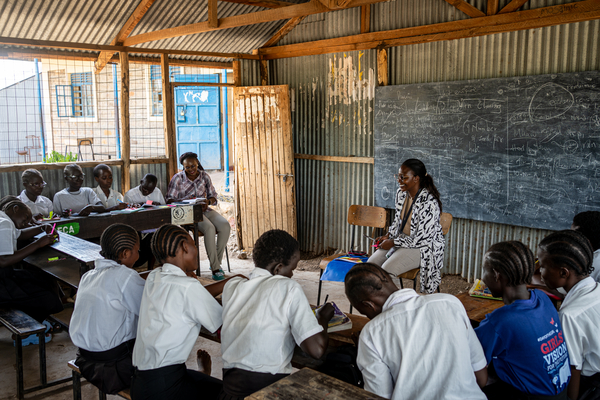
The hopes and dreams of young people in Kalobeyei are nurtured into sources of strength through positive psychology group sessions. Photo: Björn Udd, Finn Church Aid, 2025.
Richard Tsalwa, a local staff member with Finn Church Aid (FCA), explains how education in the refugee settlement differs from conventional schooling. The work falls under the concept of Education in Emergencies and Protracted Crises, which focuses on ensuring access to quality education during emergencies and prolonged crises. In such contexts, education is not only about learning — it is also life-saving and life-sustaining. Education provides access to essential services such as water, food, and healthcare, while also offering protection and stability. (Geneva Global Hub for Education et al., 2025)
“Children belong in school because there are many challenges in the community that affect them. They are safe when they are in school,” Richard says.
Carin Holmroos, a teacher who volunteered in Kalobeyei through the Teachers Without Borders in autumn 2025, witnessed first-hand the profound impact education has on children and young people in the settlement. In addition to providing meaningful daily activities and access to familiar, trusted adults, schools offer a daily meal. For many children, it is the only meal they receive that day. According to Carin, this is a concrete example of how education in the refugee settlement can be life-saving.
Valentine Moige, a local special educational needs teacher, has seen in her work how education helps refugee children and young people to rebuild their lives. She explains that school offers a chance to experience a sense of normalcy, providing routines, purpose and stability.
“To me Education in Emergencies is something that is supposed to be there in a good way to help these people get their lives back in order. Maybe it won’t be in order the way they had anticipated, but at least they can get back to safety, get back to knowing that there is growth, get back to knowing that they have potential they can reach,” Valentine says.
Challenges of Providing Quality Education
Providing education in a refugee settlement is far from easy. The work is carried out in extremely challenging conditions, making it difficult to ensure access to quality education. Richard Tsalwa explains that schools in Kalobeyei face severe shortages of classrooms, qualified teachers, and learning materials, among other essential resources. Schools and classrooms are overcrowded, and enrolment continues to rise as more children arrive in the schools of refugee settlement every day.
Schools in the settlement are exceptionally large, with student populations ranging from approximately 5,000 to 7,800 learners. The student-to-teacher ratio is extremely high, with individual classes sometimes accommodating as many as 150–200 students.
With support from U.S. funding and Finn Church Aid (FCA), it had been possible to ease some of these challenges and implement improvements that enhanced the quality of teaching and supported student learning. Schools were able to recruit qualified Kenyan teachers and psychosocial counsellors, provide support for learners with special educational needs, strengthen girls’ access to education, construct new school facilities, and procure teaching and learning materials.
As a result of the funding cuts, many of these improvements and support mechanisms have either been discontinued entirely or significantly scaled back, undermining both the quality of education and students’ opportunities to learn.
Severe Consequences of Funding Cuts
The funding cuts have had severe and wide-ranging consequences in Kalobeyei, affecting the education and learning of 36,000 students. As a result, class sizes have grown to unsustainable levels, the construction of new school buildings has been halted, and nearly all trained teachers and psychosocial counsellors have been laid off.
The loss of trained teachers has significantly weakened the quality of education while increasing the workload of school principals and the remaining teaching staff. At the same time, learning has become increasingly difficult for students, as providing individual support—and maintaining a conducive learning environment—is nearly impossible in classrooms of 150–200 learners.
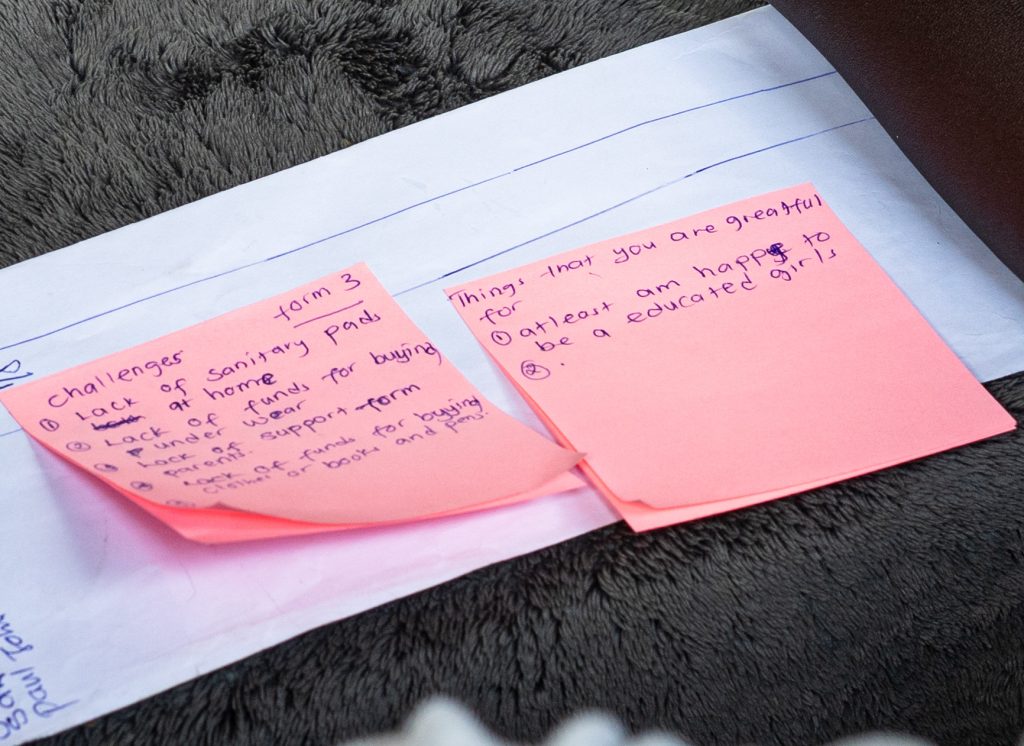
The funding cuts have also deepened inequalities in access to quality education for refugee children and young people, while further weakening the position of girls and learners with special educational needs. All interviewees highlight that girls and learners with disabilities are in an especially vulnerable position in the refugee settlement, facing intersectional discrimination that makes them more likely to drop out of school.
U.S. funding had enabled targeted support for girls, including psychosocial services and the distribution of hygiene kits. Learners with special educational needs were supported through assistive devices, the recruitment of special educational teachers, and training teachers on inclusive education.
As a result of the funding cuts, nearly all of these forms of support for girls and learners with special educational needs have been discontinued. According to interviewees, this has deepened the challenges faced by these groups and increased the discrimination they experience. The cuts have, for example, contributed to higher dropout rates and increased gender-based violence affecting girls.
Psychosocial support strengthens mental and social resilience in times of crisis. Amid challenging circumstances, young people in Kalobeyei find meaning, set new goals, and build the skills to manage their daily lives. Photo: Björn Udd, Finn Church Aid, 2025.
Hope: Where Do We Go from Here?
The changed funding landscape is forcing NGOs, governments, and other stakeholders to find new ways to respond to the needs of refugees. The interviewees agree that ensuring quality education for refugee children and young people will require a broad range of solutions—but above all, increased funding.
Richard Tsalwa hopes that the Kenyan government will make greater investments in financing and delivering education for refugees. At present, UNHCR and its partner organisations are responsible for providing and funding education in refugee camps and settlements (UNHCR, 2025). Although refugee schools have formally been integrated into Kenya’s education system, in practice the country continues to operate a two-tier system, particularly in terms of education quality (Bellino & Dryden-Peterson, 2019). On one hand, there are under-resourced refugee schools that depend on funding from humanitarian organisations; on the other, public and private schools that generally provide higher-quality education.
Richard therefore proposes that refugee schools should be fully incorporated into Kenya’s national education system. This could enable them to receive increased public funding, recruit more qualified teachers, and gain access to other essential resources.
Interviewees also highlight teacher well-being support, continuous professional development, and the use of technology in teaching as part of the solution. At the same time, stronger advocacy for education is essential to ensure that decision-makers understand the critical importance of education for refugee children and young people.
“Refugees know education can change lives, but it’s only through education you can get out of a refugee camp,” Richard says.
Päivi Lavonen
The author is a teacher and a student of Global Development Studies at Helsinki University. Päivi completed an internship with the Teachers Without Borders between November 2025 and January 2026.